
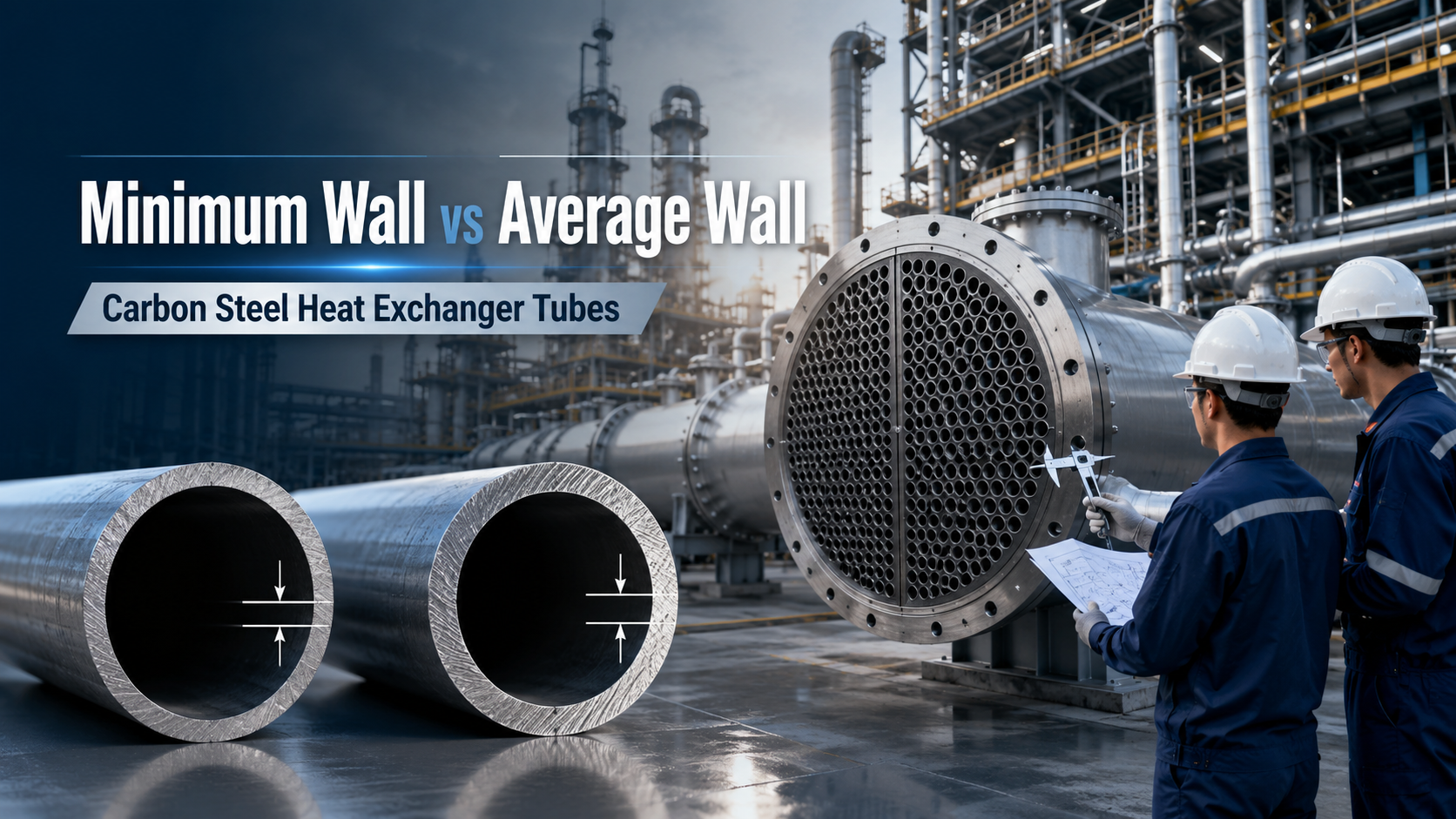
When engineers and procurement teams compare carbon steel heat exchanger tubes, wall thickness often seems like a small dimensional detail. But in real industrial applications, the difference between minimum wall and average wall can directly impact equipment reliability, thermal efficiency, fabrication quality, and overall project cost.
Whether the project involves a new heat exchanger installation, condenser replacement, feedwater heater upgrade, or a shutdown retubing job, understanding wall-thickness terminology helps buyers avoid specification mistakes that can lead to delays and expensive rework later.
In industries where uptime matters, choosing the correct carbon steel seamless tube specification is not just about purchasing steel tubing — it is about protecting long-term equipment performance.
Understanding Minimum Wall vs Average Wall
Before placing an order for heat exchanger tubes, it is important to understand what these two terms actually mean.
What is a Minimum Wall Tube?
A minimum wall tube is manufactured and inspected according to a specified minimum wall thickness requirement. Standards like ASTM A179, ASTM A214, and ASTM A556 are based on this concept.
That means:
- The tube must maintain the required minimum thickness within the permitted tolerance limits.
- Inspection focuses on ensuring the wall does not fall below specification requirements.
- It is widely used for pressure and heat-transfer applications where reliability is critical.
What is Average Wall?
Average wall refers to the average of the thickest and thinnest wall measurements in a tube cross-section. ASTM A450 describes this as the “actual mean wall.”
In simpler terms:
- One side of the tube may be thicker.
- Another side may be thinner.
- The average value may still appear acceptable.
However, in real-world fabrication and heat exchanger performance, uneven wall distribution can influence expansion behaviour, pressure handling, and tube consistency.
Why This Difference Matters in Heat Exchanger Applications
A heat exchanger is not simply a pipe assembly. Every carbon steel heat exchanger tube must:
- Transfer heat efficiently
- Withstand operating pressure
- Expand properly into the tubesheet
- Resist vibration and fatigue
- Deliver long service life
Even a small misunderstanding in wall-thickness basis can affect the entire exchanger system.
Real-World Scenario
Imagine a refinery shutdown where a plant team urgently orders replacement carbon steel seamless tubes for a condenser retubing project.
The purchase order specifies a wall thickness, but the supplier interprets it differently from the original exchanger design basis.
Once fabrication begins:
- Tube expansion becomes inconsistent
- Rolling parameters change
- Joint sealing quality suffers
- Installation delays increase downtime costs
What looked like a minor specification issue on paper suddenly becomes a major operational problem.
Pro Tip
Always confirm whether the order is written on a minimum-wall basis before approving heat exchanger tube procurement.
Common ASTM Standards Used for Carbon Steel Heat Exchanger Tubes
Several widely used specifications for carbon steel heat exchanger tubes are based on minimum wall thickness requirements.
ASTM A179
ASTM A179 covers:
- Seamless cold-drawn low-carbon steel tubes
- Tubular heat exchangers
- Condensers
- Similar heat-transfer applications
It is commonly used when high-quality surface finish and precise dimensional control are important.
ASTM A214
ASTM A214 applies to:
- Electric-resistance-welded carbon steel tubes
- Heat exchangers and condensers
It offers a cost-effective solution for many industrial heat-transfer systems.
ASTM A556
ASTM A556 is designed for:
- Seamless cold-drawn carbon steel tubes
- Feedwater heaters
- U-tube applications when specified
This specification is especially important in power generation and high-duty thermal systems.
Role of ASTM A450
ASTM A450 provides general requirements for many carbon and low-alloy steel tube specifications.
It also defines the concept of actual mean wall, helping engineers evaluate dimensional variation in tubing products.
Pro Tip
Do not assume that tubes with similar OD and thickness are automatically interchangeable. Always verify the governing ASTM specification and inspection basis.
How Wall Thickness Impacts Heat Exchanger Performance
1. Compliance and Inspection
Inspection teams evaluate tubes according to the governing standard — not visual similarity.
For example:
- ASTM A179 heat exchanger tubes must comply with minimum-wall requirements.
- Dimensional acceptance depends on specification tolerance limits.
A tube that “looks acceptable” may still fail inspection if it does not meet the specified wall-thickness basis.
Practical Benefit
Correct specification matching reduces rejection risks during QA inspection and fabrication.
2. Thermal Performance
Wall thickness directly affects heat transfer.
Thicker walls create greater thermal resistance because heat must travel through more metal.
Carbon steel has lower thermal conductivity compared to materials like copper alloys. Engineering Toolbox lists carbon steel thermal conductivity at approximately 45 W/mK.
Example
If a 3/4-inch OD carbon steel tube wall increases from 1.65 mm to 1.83 mm:
- Thermal resistance increases
- Bundle weight increases
- Material cost increases
While the exchanger may still function, unnecessary thickness can reduce overall efficiency when multiplied across hundreds or thousands of tubes.
Pro Tip
Do not automatically select thicker walls “for safety.” Match wall thickness to actual pressure, corrosion allowance, and thermal duty.
3. Tube Expansion and Fabrication
Tube expansion into the tubesheet requires precise dimensional control.
Fabricators must consider:
- Tube OD
- Wall thickness
- Hole diameter
- Target wall reduction
- Rolling parameters
Even slight wall variation can affect:
- Joint sealing quality
- Expansion consistency
- Leak resistance
Real Workshop Example
A fabrication contractor once received replacement carbon steel heat exchanger tubes with inconsistent wall distribution.
During rolling:
- Some joints expanded correctly
- Others required rework
- Additional inspection time delayed exchanger delivery
The issue was not material quality — it was dimensional mismatch.
Practical Benefit
Proper wall-thickness selection improves fabrication efficiency and reduces workshop complications.
4. Weight and Project Cost
More steel means:
- Higher raw material costs
- Increased bundle weight
- More difficult handling
- Higher transportation expenses
Many buyers over-specify wall thickness assuming it guarantees better reliability. In reality, excessive thickness may only increase project costs without improving performance.
Pro Tip
The best heat exchanger tube selection balances:
- Mechanical strength
- Thermal efficiency
- Fabrication suitability
- Project economics
Quick Comparison Table
| Project Question | Why It Matters | What to Check |
|---|---|---|
| Is the order based on a minimum-wall specification? | Determines inspection and acceptance criteria | Confirm ASTM A179, ASTM A214, ASTM A556, or applicable standard |
| Will thicker walls improve performance? | Not always — may increase resistance and cost | Review pressure, corrosion allowance, and thermal duty |
| Is tube expansion required? | Wall variation affects rolling quality | Match dimensions with fabrication method |
| Is it a retubing project? | Existing geometry requires accurate matching | Verify OD, wall basis, and tubesheet layout |
Four Situations Where Buyers Notice the Difference Immediately
1. New Equipment Projects
In new heat exchanger manufacturing, engineering drawings, purchase orders, and QA documentation must all use the same wall-thickness language.
If procurement interprets specifications differently from engineering, confusion often appears during inspection or fabrication.
Pro Tip
Align engineering and purchasing teams before issuing the RFQ.
2. Retubing and Shutdown Jobs
Retubing projects demand precise dimensional matching because the exchanger geometry already exists.
Simply matching OD is not enough.
The new carbon steel seamless tube must also match:
- Wall-thickness basis
- Expansion behaviour
- Original fabrication intent
Practical Benefit
Correct dimensional matching reduces downtime during plant shutdowns.
3. High-Duty Service Conditions
Applications like:
- Feedwater heaters
- Condensers
- High-pressure heat exchangers
require careful wall-thickness evaluation because pressure handling and thermal stress become more critical.
ASTM A556 tubes are commonly selected for these demanding services.
Pro Tip
Choose heat exchanger tubes based on operating conditions — not just standard dimensions.
4. Cost-Sensitive Procurement
Some buyers attempt to simplify procurement by treating all wall-thickness descriptions as commercially equivalent.
This often leads to:
- Inspection disputes
- Delayed fabrication
- Additional rework
- Performance concerns
Practical Benefit
Accurate specification alignment reduces hidden lifecycle costs.
What Buyers Should Verify Before Ordering Carbon Steel Heat Exchanger Tubes
Before finalising a purchase order, confirm the following:
- Governing ASTM specification
- Minimum-wall or average-wall basis
- OD, wall thickness, and tube length
- Whether the tube will be expanded, welded, bent, or retubed
- Inspection and documentation requirements
- Corrosion allowance requirements
- Fabrication compatibility
These checks help engineering, procurement, fabrication, and QA teams stay aligned throughout the project.
Conclusion
The difference between minimum wall and average wall in carbon steel heat exchanger tubes is far more than a technical wording issue. It directly affects compliance, thermal efficiency, fabrication consistency, exchanger reliability, and project cost.
For industrial buyers, the smartest approach is to match the wall-thickness basis to:
- The governing ASTM specification
- Actual service conditions
- Fabrication requirements
- Long-term operational goals
Understanding these details early helps prevent delays, reduce rework, and improve overall heat exchanger performance.
Whether the project involves new installations, replacement bundles, or shutdown retubing work, choosing the right carbon steel seamless tube specification can make the entire process smoother, safer, and more cost-effective.
South India Tubes supports industrial buyers with application-focused knowledge and dependable carbon steel heat exchanger tube solutions designed for real-world performance and fabrication requirements.


