
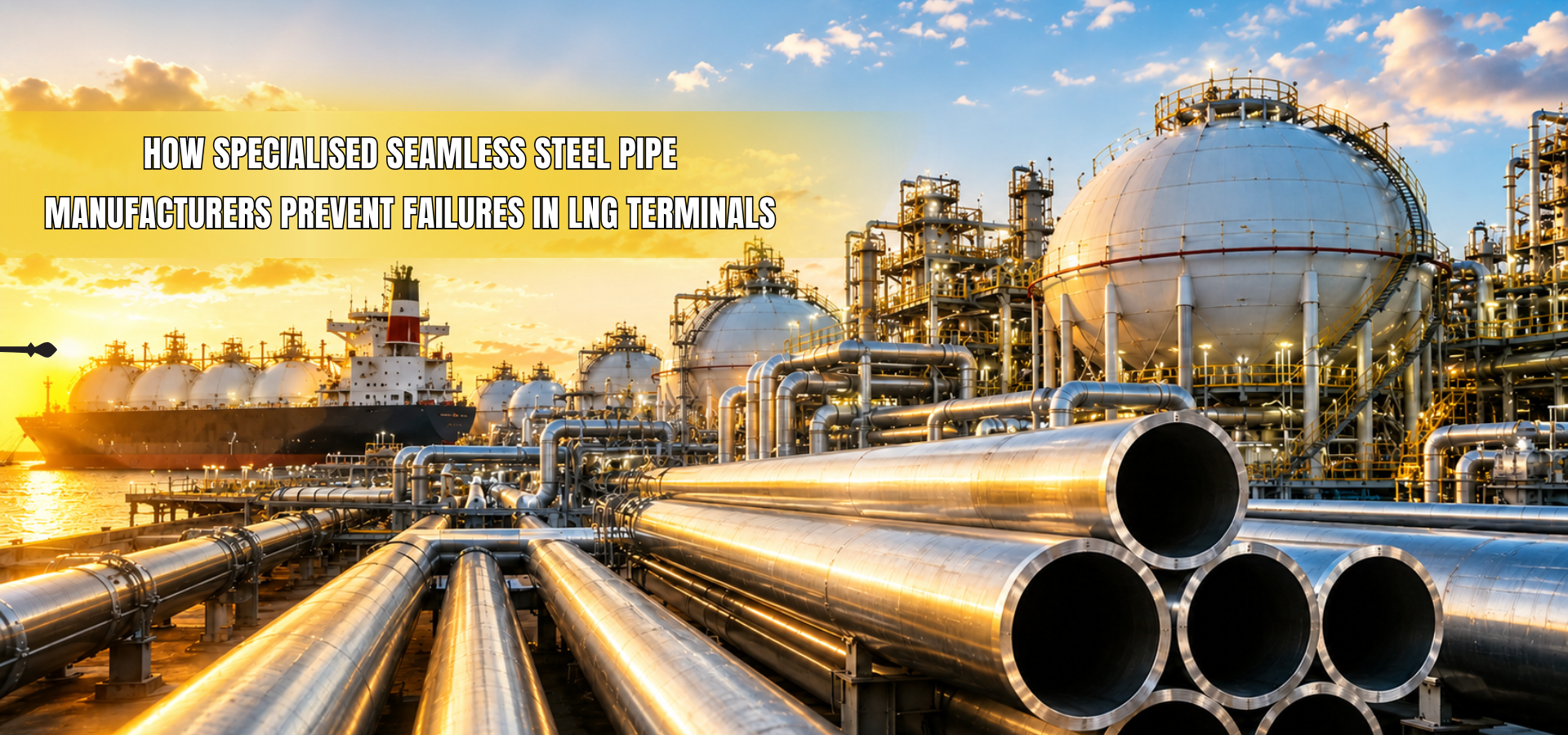
Liquefied Natural Gas (LNG) terminals operate in some of the harshest industrial environments on the planet. At temperatures as low as -162°C (-260°F), even small material weaknesses can turn into major safety risks. In these conditions, piping systems must perform flawlessly under extreme pressure, rapid thermal contraction, and continuous operational stress.
That is why global energy companies rely heavily on specialised seamless steel pipe manufacturers for critical LNG infrastructure. Unlike conventional welded pipes, seamless steel pipes are designed to deliver uniform strength, superior toughness, and long-term reliability in cryogenic applications.
For LNG projects, the right piping solution is not just about transporting gas safely — it is about protecting plant uptime, preventing leaks, and ensuring decades of operational stability.
Why LNG Terminals Demand Extremely Reliable Piping Systems
Transporting natural gas in liquid form dramatically reduces its volume, making storage and marine transportation more efficient. However, this process also creates intense stress on industrial piping systems.
At cryogenic temperatures:
- Metals contract rapidly
- Pressure cycles become more severe
- Thermal shock increases material fatigue
- Structural weak points become vulnerable
A single piping failure inside an LNG terminal can lead to:
- Boil-off gas leaks
- Emergency shutdowns
- Fire hazards
- Massive financial losses
This is why specialised seamless steel pipe manufacturers focus heavily on structural integrity and precision engineering.
Real-World Example
Imagine an LNG export terminal during peak loading operations. Thousands of cubic meters of super-cooled LNG move through transfer lines every hour.
If even one welded seam develops microscopic fatigue cracks due to repeated thermal contraction:
- Leakage risks increase
- Production halts immediately
- Inspection and repair costs escalate rapidly
This is exactly why most high-pressure LNG systems prefer seamless steel pipes over conventional welded alternatives.
Pro Tip
For cryogenic projects, always prioritise seamless piping solutions designed specifically for low-temperature service conditions.
Why Welded Pipes Struggle in LNG Applications
Welded pipes contain a longitudinal seam where the metal structure differs slightly from the surrounding material.
This creates:
- Heat-affected zones
- Uneven stress distribution
- Higher fatigue risk during thermal cycling
In LNG terminals, pipes constantly shift between:
- Ambient environmental temperatures
- Deep cryogenic operating conditions
Repeated contraction and expansion place enormous strain on welded seams over time.
How Seamless Steel Pipes Improve Structural Reliability
Seamless steel pipe manufacturers eliminate this weakness by producing pipes from a single solid steel billet.
The result:
- No weld seam
- Uniform grain structure
- Better pressure resistance
- Improved thermal stress distribution
This allows the pipe to expand and contract evenly across the entire circumference without creating concentrated stress points.
Practical Benefit
Seamless steel pipes significantly reduce the risk of fatigue-related failures in LNG transfer systems.
How Seamless Steel Pipe Manufacturers Prevent Brittle Fracture
One of the biggest dangers in cryogenic environments is brittle fracture.
At extremely low temperatures, ordinary carbon steel can lose ductility and behave like glass. Sudden impact or pressure surges may cause catastrophic cracking.
Specialised seamless steel pipe manufacturers prevent this through advanced material selection and controlled manufacturing processes.
1. Cryogenic Impact Toughness Testing
Before pipes are approved for LNG service, manufacturers perform rigorous impact testing.
Charpy V-Notch Testing
This test measures how much energy the steel can absorb before fracturing.
The process involves:
- Cooling steel samples to cryogenic temperatures
- Striking the sample with a pendulum hammer
- Measuring fracture resistance
High-quality seamless steel pipes:
- Bend slightly under stress
- Absorb impact energy
- Resist sudden cracking
Real Industry Scenario
During commissioning at a coastal LNG facility, operators detected sudden pressure fluctuations caused by rapid loading changes.
Because the installed seamless steel piping maintained high impact toughness, the system safely absorbed the stress without structural damage.
Pro Tip
Always verify low-temperature impact testing certifications before approving cryogenic piping materials.
2. Selecting the Right Material Grade
Material selection plays a critical role in LNG safety.
ASTM A333 Grade 6 for Cryogenic Service
ASTM A333 Grade 6 is widely used for:
- LNG terminals
- Low-temperature process plants
- Cryogenic transfer lines
Leading seamless steel pipe manufacturers carefully control:
- Carbon levels
- Manganese content
- Heat treatment parameters
This ensures the steel maintains:
- Toughness
- Strength
- Ductility at low temperatures
Practical Benefit
Using certified cryogenic grades helps prevent unexpected brittle failures during long-term LNG operations.
3. Managing Thermal Contraction Efficiently
Extreme cold causes metals to shrink significantly.
Uneven wall thickness can create:
- Stress concentration points
- Expansion inconsistencies
- Structural instability
Advanced seamless pipe manufacturing processes help maintain:
- Uniform wall thickness
- Consistent dimensional accuracy
- Balanced stress distribution
This is essential for LNG pipelines that experience daily thermal cycling.
Pro Tip
Uniform wall thickness improves long-term reliability in cryogenic transfer systems.
How Seamless Steel Pipes Are Manufactured
The reliability of a seamless steel pipe begins with the manufacturing process itself.
Step-by-Step Seamless Pipe Manufacturing Process
1. Billet Heating
Manufacturers start with a solid cylindrical steel billet.
The billet is heated until it becomes highly malleable.
2. Piercing Process
A powerful piercing mill forces a mandrel through the centre of the billet.
This creates:
- A hollow shell
- No seams
- No welded joints
3. Rolling and Sizing
The pipe is then:
- Rolled
- Stretched
- Sized precisely
to achieve the required:
- Diameter
- Wall thickness
- Mechanical properties
Why This Process Matters
This manufacturing method creates:
- Superior grain structure
- Higher pressure resistance
- Better fatigue performance
- Improved cryogenic durability
Compared to welded alternatives, seamless steel pipes offer much stronger structural consistency.
Practical Benefit
Heavy-wall seamless pipes are ideal for high-pressure LNG applications where reliability is critical.
Advanced Quality Testing That Prevents LNG Failures
Top seamless steel pipe manufacturers perform strict non-destructive testing before shipment.
This ensures every pipe can safely operate under extreme LNG conditions.
1. Ultrasonic Testing
Ultrasonic testing uses high-frequency sound waves to detect hidden defects.
It helps identify:
- Internal cracks
- Tiny air pockets
- Wall inconsistencies
- Structural discontinuities
This testing is essential because many microscopic flaws are invisible during visual inspection.
Pro Tip
Always request ultrasonic testing reports for critical LNG piping projects.
2. Hydrostatic Pressure Testing
Hydrostatic testing physically verifies pipe strength.
Manufacturers:
- Seal both pipe ends
- Fill the pipe with water
- Apply extremely high pressure
The pipe must withstand pressure beyond normal operating limits without:
- Leaks
- Bulging
- Permanent deformation
Real-World Example
One LNG contractor rejected an entire shipment after hydrostatic failures exposed weak wall sections in improperly manufactured pipes.
This prevented major field failures later during plant startup.
Practical Benefit
Hydrostatic testing reduces the risk of unexpected pressure-related failures in operation.
3. Positive Material Identification (PMI)
Even a small material mix-up can create serious safety hazards.
Positive Material Identification helps verify:
- Alloy chemistry
- Material grade
- Compliance with specifications
Manufacturers often use handheld X-ray fluorescence devices for real-time material verification.
Pro Tip
Always match PMI reports with mill test certificates before installation.
Common Questions Procurement Teams Ask
How are seamless pipes joined during LNG construction?
Contractors typically use advanced orbital welding methods combined with post-weld heat treatment to maintain uniform stress resistance.
What is the lifespan of cryogenic seamless steel pipes?
With proper insulation and maintenance, seamless cryogenic pipelines can safely operate for 25–30 years or longer.
Do LNG pipes require protective coatings?
Yes. Coastal LNG terminals expose pipes to saltwater corrosion. Protective coatings like:
- Thermal spray aluminium
- High-build epoxy coatings
help extend service life.
How is external ice buildup prevented?
Facilities use:
- Cellular glass insulation
- Polyurethane foam systems
- Vapour barriers
to minimise moisture penetration and heat transfer.
Are there size limitations for seamless pipes?
The billet extrusion process limits very large diameters. For extremely large transfer lines, some projects may use specialised welded alternatives for practical reasons.
What Buyers Should Verify Before Ordering Seamless Steel Pipes for LNG Projects
Before placing an order, procurement teams should confirm:
- Cryogenic material grade compliance
- ASTM/API certification requirements
- Impact testing documentation
- Hydrostatic testing reports
- Ultrasonic inspection standards
- Wall thickness consistency
- Coating and corrosion protection requirements
- Dimensional tolerances
These checks help reduce project delays, inspection issues, and long-term operational risks.
Conclusion
LNG terminals push industrial materials to their absolute limits. At cryogenic temperatures, even minor structural weaknesses can become major safety threats.
This is why experienced operators depend on specialised seamless steel pipe manufacturers that understand:
- Cryogenic metallurgy
- Structural integrity
- Thermal stress behaviour
- High-pressure industrial applications
From impact toughness and precise alloy selection to advanced flaw detection and hydrostatic testing, seamless steel pipes play a critical role in ensuring LNG facility safety and reliability.
For procurement teams, choosing the right manufacturing partner helps:
- Prevent costly failures
- Improve plant uptime
- Reduce maintenance risks
- Ensure long-term infrastructure performance
South India Tubes supports industrial buyers with dependable seamless steel pipe solutions designed for demanding cryogenic and high-pressure applications where reliability matters most.


