
Aerospace manufacturing is one of the most demanding fields in engineering. Every component must perform with accuracy, strength, and reliability because even a small material failure can affect safety and performance. From hydraulic systems and fuel lines to actuator cylinders and landing gear components, aerospace parts are exposed to high pressure, temperature changes, vibration, and repeated mechanical stress.
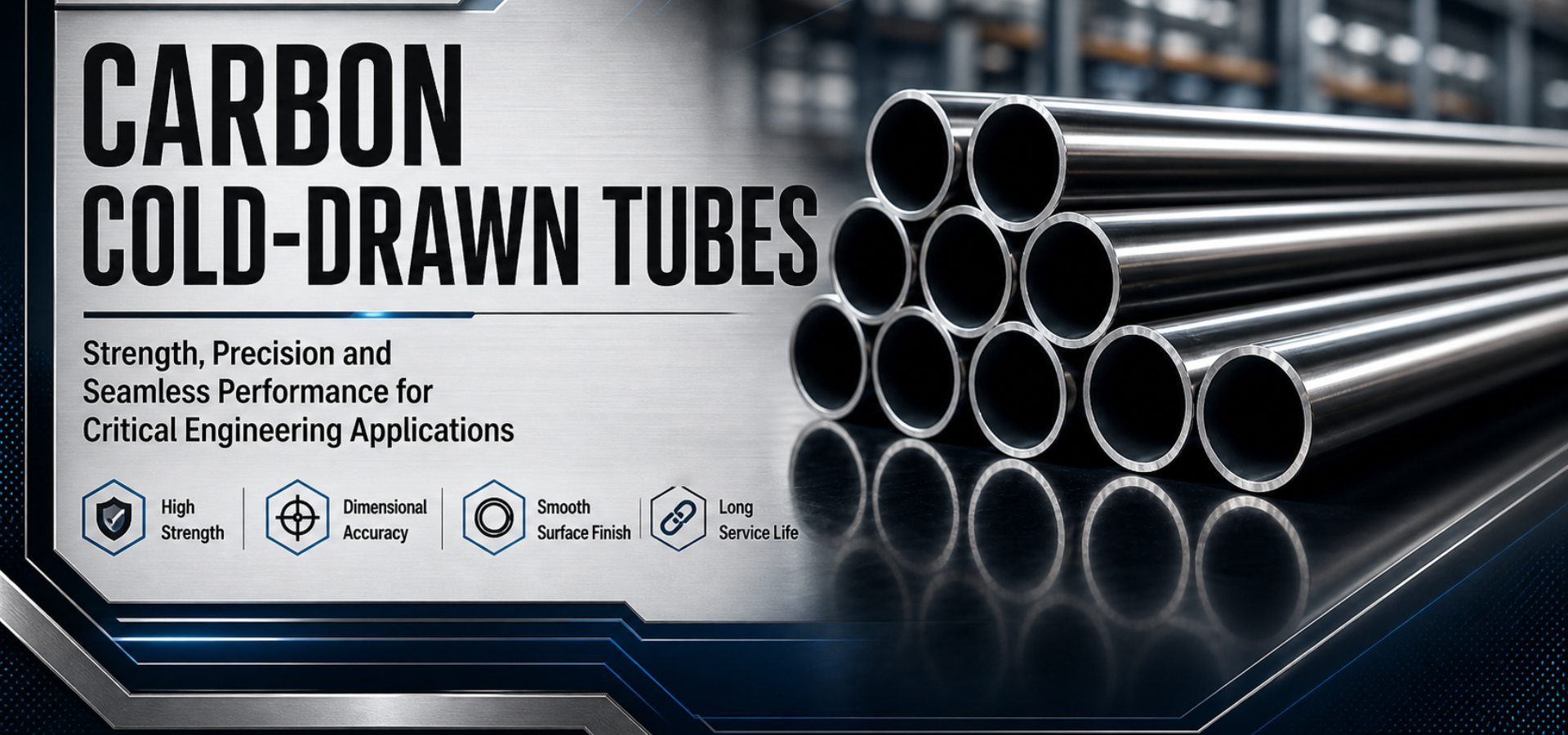
This is where cold-drawn tubes become an important material choice. These tubes are known for their seamless structure, excellent dimensional accuracy, smooth surface finish, and strong mechanical properties. For aerospace component manufacturing, cold-drawn seamless tubes offer the consistency and durability required for critical applications.
In this blog, we will understand what cold-drawn tubes are, why they are preferred in aerospace manufacturing, and how they help improve safety, performance, and long-term reliability.
What Are Cold-Drawn Tubes?
Cold-drawn tubes are precision-engineered seamless tubes manufactured through a cold drawing process. In this process, a tube is pulled through a die at room temperature to improve its size accuracy, wall thickness consistency, surface finish, and mechanical strength.
Unlike welded tubes, cold-drawn seamless tubes do not have a welded joint. This makes them stronger and more uniform across the entire length. The cold drawing process also refines the metal structure, which improves tensile strength, fatigue resistance, and dimensional precision.
In simple words, cold-drawn tubes are designed for applications where ordinary tubing may not provide the required level of safety, accuracy, and durability.
Real-World Example
Think about an aircraft hydraulic system that controls landing gear movement. The tube carrying hydraulic fluid must handle high pressure again and again without cracking, leaking, or deforming. A cold-drawn seamless tube provides the strength and precision needed for such mission-critical aerospace systems.
Pro Tip
When selecting tubes for aerospace applications, always check three important factors: seamless construction, tight dimensional tolerance, and consistent mechanical strength.
Why Cold-Drawn Tubes Matter in Aerospace Manufacturing
Aerospace components work in challenging conditions. During flight, aircraft parts experience pressure changes, vibration, temperature variation, and mechanical load. During takeoff and landing, some components also face sudden impact and repeated stress cycles.
Cold-drawn tubes are valuable because they offer a strong combination of:
- High strength-to-weight ratio
- Excellent dimensional precision
- Smooth internal and external surface finish
- High fatigue resistance
- Better pressure-bearing capacity
- Long service life
- Seamless construction with no weld weakness
These qualities make cold-drawn tubes suitable for both structural and fluid-carrying aerospace components.
Key Takeaway
In aerospace manufacturing, tube selection should not be based only on cost. It should be based on performance consistency, safety margin, and long-term reliability.
1. High Strength-to-Weight Ratio
Weight reduction is a major priority in aerospace design. A lighter aircraft can improve fuel efficiency, increase payload capacity, and reduce operating costs. However, reducing weight should never reduce strength.
Cold-drawn tubes offer an excellent strength-to-weight ratio, making them suitable for aerospace applications where components must remain lightweight but strong enough to handle high stress.
These tubes are commonly used in:
- Aircraft hydraulic tubes
- Fuel lines
- Actuator cylinders
- Landing gear systems
- Structural support components
For example, hydraulic tubes in aircraft must carry pressurized fluid to operate systems such as brakes, landing gear, and flight control surfaces. These tubes must be light enough to support aircraft efficiency but strong enough to withstand pressure, vibration, and stress.
Cold-drawn tubes help meet both requirements.
Pro Tip
For high-pressure aircraft systems, select cold-drawn seamless tubes with verified tensile strength, pressure rating, and material certification suitable for the exact application.
2. Dimensional Precision and Consistency
Precision is extremely important in aerospace manufacturing. Even a small variation in tube diameter, wall thickness, or surface quality can affect the performance of a complete system.
Cold-drawn tubes are known for tight tolerances and consistent dimensions. This makes them ideal for components where exact fitment is required.
For example, actuator cylinders need accurate internal dimensions to ensure smooth movement and proper fluid control. If the tube is not dimensionally accurate, the actuator may face leakage, friction, or poor movement.
Cold-drawn tubes also offer a smooth surface finish, which helps reduce friction and improves the performance of moving or fluid-carrying components.
Where Dimensional Precision Matters
- Actuator cylinders
- Hydraulic systems
- Precision mechanical assemblies
- Aircraft fuel systems
- Aerospace heat exchanger tubing
Pro Tip
For precision aerospace components, always check tolerance requirements for outer diameter, inner diameter, wall thickness, straightness, and surface finish before selecting tubes.
3. Seamless Construction Eliminates Weak Points
One of the biggest advantages of cold-drawn tubes is their seamless construction. Welded tubes have a joint area that can become a weak point under stress, pressure, or corrosion. In aerospace applications, such weak points can create serious risks.
Cold-drawn seamless tubes provide uniform strength throughout the entire tube length. This makes them more reliable for high-pressure and high-stress applications.
In aerospace, this is especially important for:
- Hydraulic tubes
- Landing gear components
- Fuel lines
- Actuator systems
- Engine-related tubing
- High-pressure fluid transfer systems
A seamless tube reduces the chances of leakage, rupture, and fatigue failure. This makes it a safer choice for critical aircraft systems.
Real-World Scenario
During landing, the landing gear absorbs heavy impact. If a tube or tubular component has weak points, repeated stress cycles can lead to fatigue failure. Cold-drawn seamless tubes reduce this risk by offering uniform mechanical strength.
Pro Tip
For safety-critical aerospace applications, seamless cold-drawn tubes are often a better choice than welded tubes because they remove weld-related failure risks.
4. Better Fatigue Resistance for Repeated Stress Cycles
Aircraft components are exposed to repeated stress during every flight cycle. Takeoff, cruising, landing, vibration, braking, and pressure changes all place continuous load on aerospace parts.
Cold-drawn tubes are designed to withstand these repeated stress cycles. Their refined grain structure and improved mechanical properties help them resist fatigue better than many conventional tube options.
This is especially useful for:
- Landing gear systems
- Aircraft hydraulic lines
- Actuator cylinders
- Control system tubing
- Structural tube assemblies
Fatigue resistance is important because aerospace components must perform reliably over thousands of operating cycles.
Key Takeaway
Cold-drawn tubes improve aerospace reliability by reducing the risk of cracks, deformation, and fatigue-related failure.
Pro Tip
For parts exposed to repeated load cycles, ask for fatigue performance data, inspection reports, and material test certificates before final selection.
5. Thermal Stress Resistance in Extreme Conditions
Aerospace environments involve major temperature changes. Components may face high temperatures near engines and extremely low temperatures at high altitudes. Materials used in aerospace must handle thermal cycling without warping, cracking, or losing strength.
Cold-drawn tubes offer good thermal stress resistance because of their uniform structure and consistent wall thickness. They expand and contract more predictably under temperature variation, helping maintain dimensional stability.
This makes them useful in:
- Jet engine support systems
- Fuel systems
- Heat exchangers
- Aerospace cooling systems
- High-temperature fluid transfer lines
In heat exchanger applications, related components such as stainless steel fin tubes can also play an important role. Stainless steel fin tubes help improve heat transfer efficiency, especially in systems where thermal regulation is critical.
Pro Tip
For aerospace applications exposed to heat, choose tube materials based on operating temperature, pressure, corrosion exposure, and thermal cycling frequency.
6. Smooth Surface Finish Improves Performance
Surface quality is a major factor in aerospace tubing performance. Rough surfaces can increase friction, reduce flow efficiency, and create stress concentration points.
Cold-drawn tubes generally offer a superior surface finish compared to many hot-rolled or welded tube options. A smoother internal surface supports better fluid flow, while a smoother external surface reduces the chances of surface-related defects.
This is useful in systems such as:
- Hydraulic tubes
- Fuel lines
- Pneumatic systems
- Heat exchangers
- Precision moving components
A smooth surface finish also supports better coating, plating, or surface treatment when additional protection is required.
Real-World Example
In an aircraft hydraulic system, smooth internal tube surfaces help maintain efficient fluid movement. This can improve system response and reduce unnecessary pressure loss.
Pro Tip
For fluid-carrying aerospace tubes, internal surface finish is just as important as external appearance. Always evaluate both.
7. Corrosion Resistance and Long-Term Durability
Aerospace components must often work in challenging environments where moisture, chemicals, fuel, and temperature changes can affect material performance.
Cold-drawn tubes, especially when produced using suitable steel grades or stainless steel, offer strong durability and corrosion resistance. They can also be enhanced through heat treatment, coatings, or surface finishing processes.
This helps improve the lifespan of aerospace components and reduces maintenance requirements.
Cold-drawn tubes are valuable in applications where long-term reliability matters, such as:
- Aircraft fuel lines
- Hydraulic systems
- Aerospace structural tubes
- Cooling systems
- Heat exchanger tubes
- Landing gear-related components
Key Takeaway
Durable tubing reduces downtime, maintenance frequency, and replacement costs in aerospace manufacturing.
Pro Tip
Select the tube material grade based on the working environment. For corrosion-prone applications, stainless steel or specially treated cold-drawn tubes may be more suitable.
8. Versatility Across Aerospace Applications
Cold-drawn tubes are not limited to one type of aerospace component. Their strength, precision, and durability make them useful across multiple aerospace systems.
Hydraulic Tubes
Cold-drawn tubes are used in aircraft braking systems, landing gear systems, and flight control systems where high pressure resistance is essential.
Actuator Cylinders
Actuator cylinders control mechanical movement in aircraft systems. They require tight tolerances, smooth internal surfaces, and reliable strength.
Fuel Lines
Fuel lines need safe and efficient fuel transfer. Cold-drawn seamless tubes can handle pressure, vibration, and corrosion exposure.
Landing Gear Components
Landing gear components must withstand impact, load, and repeated stress cycles. Cold-drawn tubes support durability in these demanding conditions.
Heat Exchangers
Heat exchangers help regulate temperature in aerospace systems. Stainless steel fin tubes and precision tubes can improve thermal efficiency.
Engine and Structural Components
Cold-drawn tubes are also used where strength, dimensional accuracy, and long-term performance are required.
Pro Tip
Before selecting a cold-drawn tube, define the exact end-use application. Hydraulic tubing, structural tubing, and heat exchanger tubing may require different grades, tolerances, and finishes.
Cold-Drawn Tubes vs Welded Tubes in Aerospace Manufacturing
Both welded tubes and seamless cold-drawn tubes are used in industrial applications. However, aerospace manufacturing often demands higher reliability and performance consistency.
| Feature | Cold-Drawn Seamless Tubes | Welded Tubes |
|---|---|---|
| Strength Uniformity | High uniform strength | Weld area may be weaker |
| Dimensional Accuracy | Excellent | Moderate to good |
| Surface Finish | Smooth and precise | Depends on welding and finishing |
| Fatigue Resistance | Better for critical applications | May vary near weld zone |
| Pressure Handling | Strong performance | Weld quality is critical |
| Aerospace Suitability | Preferred for critical systems | Suitable for less demanding uses |
Key Takeaway
For safety-critical aerospace systems, cold-drawn seamless tubes often provide better reliability than welded tubes.
Pro Tip
Use welded tubes only where the application allows it. For high-pressure, high-stress, or safety-critical aerospace components, cold-drawn seamless tubes are usually the stronger choice.
How Cold-Drawn Tubes Improve Aerospace Manufacturing Quality
Using cold-drawn tubes can help aerospace manufacturers improve product quality in several practical ways.
They help with:
- Better fitment in precision assemblies
- Reduced risk of leakage in fluid systems
- Improved resistance to vibration and fatigue
- Higher safety margin in critical components
- Longer component service life
- Better performance under pressure and temperature changes
- Reduced maintenance and replacement needs
For manufacturers, this means fewer quality issues, better product reliability, and stronger confidence in mission-critical systems.
Pro Tip
For aerospace manufacturing, always combine material selection with proper inspection, testing, and documentation. Tube quality is complete only when it is supported by reliable certification and quality checks.
Important Factors to Consider Before Choosing Cold-Drawn Tubes
Before selecting cold-drawn tubes for aerospace components, manufacturers should evaluate:
- Material grade
- Tube size and wall thickness
- Dimensional tolerance
- Surface finish requirement
- Pressure rating
- Temperature range
- Fatigue resistance
- Corrosion resistance
- Heat treatment condition
- Testing and certification requirements
- End-use application
This helps ensure that the selected tube matches the technical and safety requirements of the aerospace system.
Pro Tip
Do not select aerospace tubing based on standard size alone. Match the tube specification with actual operating pressure, movement, load, temperature, and environmental exposure.
Conclusion
Cold-drawn tubes are one of the most reliable choices for aerospace component manufacturing because they offer the right combination of strength, precision, durability, and safety. Their seamless construction removes weld-related weak points, while their tight tolerances and smooth surface finish support high-performance aerospace systems.
From hydraulic tubes and actuator cylinders to fuel lines, heat exchangers, and landing gear components, cold-drawn tubes help aerospace manufacturers build components that can perform under pressure, temperature variation, vibration, and repeated stress cycles.
For aerospace applications where failure is not an option, cold-drawn seamless tubes provide the consistency and confidence manufacturers need.
Cold-Drawn Tubes from South India Tubes Pvt. Ltd
South India Tubes Pvt. Ltd provides cold-drawn tubes engineered for demanding industrial and aerospace applications. With a focus on precision, strength, and reliability, the company supports manufacturers that require high-performance seamless tubes for critical components such as hydraulic systems, actuator cylinders, fuel lines, and other precision-engineered applications.
By choosing high-quality cold-drawn tubes from South India Tubes Pvt. Ltd, aerospace manufacturers can improve component performance, reduce failure risks, and support long-term operational reliability.


